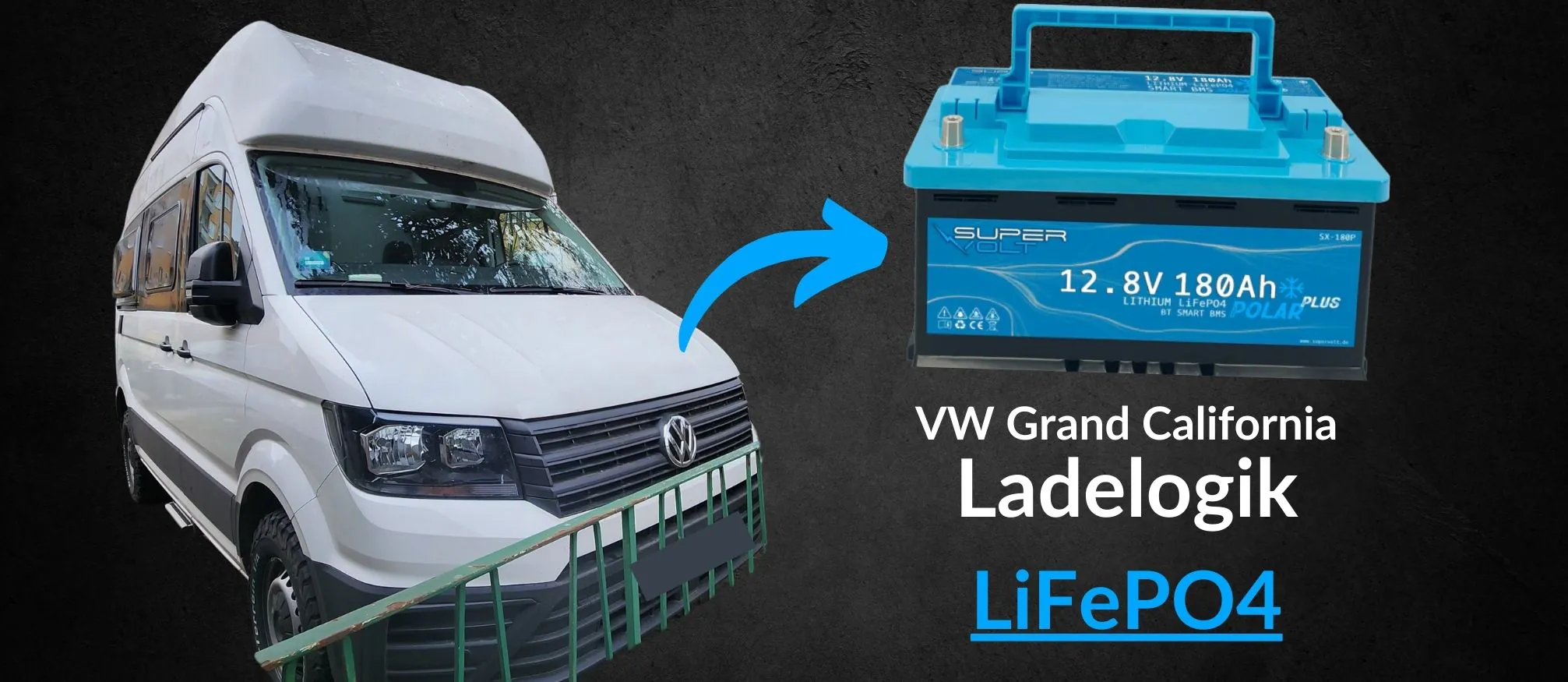
Guest article on the conversion of the charging logic in the VW Grand California
In this very detailed report, our customer Joachim explains how he converted the charging logic of the VW alternator in the VW Grand California to “lithium-ion” and what to look out for. Joachim has installed our Supervolt SX 180 P with (180 Ah) in his VW Grand California.
Table of contents
Note
For the Grand California we recommend our Supervolt Ultra – 12.8V 150Ah High Power LiFePO4 high-performance battery with Bluetooth, heating and integrated balancer. This has no RJ45 ports and has IP65 protection. This means that 100 percent waterproofness can be guaranteed. If you have any further questions, please contact our technical support:
Converting the charging logic of the VW alternator to "lithium-ion" using the VCDS software and OBD.dongle
[As well as (see last page) with the help of CarScannerPro App and VeePeak dongle]
When installing a Li-ion battery in my Crafter/Grand-Galifornia, Supervolt
supplies a charger that charges the Li-ion battery
with 30 or 60 A and the correct voltage independently of the vehicle’s charging logic.
The factory setting of the Crafter’s alternator is said to charge with up to 200 A and with a slightly higher voltage (suitable for lead batteries) than recommended for the lithium battery. As an alternative to using a specialized charger, it is also possible to convert the VW alternator to the “lithium-ion” battery type [according to Internet forums].
I have made this adjustment to the charging logic of the alternator on my Grand California Model 2024 (model before the mid-2024 facelift). It is possible to change the charging logic of the VW alternator via the OBD connector in the vehicle.
There are many connection dongles and software for the OBD connector.
Here I report on my experience with the VCDS connector and VCDS Windows
program on the laptop. This is not the cheapest solution (see notes on the
CarScanner app below)!
You have to buy the VCDS dongle [“VCDS Diagnostic Tool Interface (USB) for VW, Audi, Seat and Skoda vehicles”] including a license e.g. for at least 3 VW Group vehicles, costs approx. €300:
https://www.vcds-shop.de/ross-tech-vcds-hex-v2-hobby-3er-limit/?c=540
[There is also a wireless version (Wlan?) as a VCDS dongle, but it is more expensive.
I have no experience with this].
Then install the latest version of the free VCDS software for Windows on the
laptop.
https://www.vcds-shop.de/vcds-download/
You have to register to activate the software.
Then:
- Plug the dongle into the OBD connector of the vehicle and into the USB port of the laptop.
- Unlock the hood (does not have to be opened completely) otherwise the write operations will not work (this is probably intended as hacker protection).
- Switch on the ignition [not the engine!]
- (sometimes you also read:) "additionally apply the handbrake". I have not tried to save changes without the handbrake on.
Start the CDS software on the laptop.
First carry out the connection test under “Settings”.
Fig. 9:
IMPORTANT: If you now start the engine, the lithium battery will NOT be charged immediately!
Only when you press the battery charge button (Fig. 9 left) does the alternator supply charging current
for the lithium-ion body battery and charge it to 100%.
This is because the lithium battery, unlike a lead battery, shows no voltage drop when it is half or 3/4 empty, for example.
is empty, there is no voltage drop. The VW alternator therefore does not “know” (unlike the lead
battery) that the lithium battery is half empty, so the alternator does not charge the lithium
lithium battery, and certainly not 100% full. When the battery charge switch is pressed
both lead-acid and lithium body batteries are fully charged.
I also always switch off the automatic start-stop function “(A)OFF” for the engine (Fig. 9 right),
if the battery is not yet fully charged, because I don’t think it makes sense to interrupt the battery charging
to interrupt the battery charging process at every traffic light.
My observations
AFTER ADAPTING THE VW ALTERNATOR TO LITHIUM CHARGING LOGIC:
I have repeatedly checked the charging current at idle and while driving in the Supervolt battery app at
for my Supervolt SX 180 P with (180 Ah) and with a half-full battery I saw a
charging current of approx. 60-77 A, sometimes 82 A, with voltages of 13.29V,
13.61V, 13.52V, 13.34V. This is considered to be compatible with the battery. However, I have not tested
whether the BMS of the battery would charge with
higher amperage values without first changing the charging logic of the VW alternator or whether the BMS (Battery Management System) of the battery
would regulate the charging current down anyway.
The observed charging current of up to 82 amps is therefore considerably higher than the recommended 50
amps, but in view of the battery capacity of 180 Ah, this is OK according to Mr. Bauer from Supervolt
, as up to half the capacity (180/2=90) is acceptable as a charging current.
If you install a smaller lithium-ion battery, e.g. 100Ah, you should check and
possibly discuss with Mr. Bauer from Supervolt whether, despite the lithium-ion setting of the
charging logic of the VW alternator, too high a charging current (e.g. 100A) or too high a
charging voltage is being offered. In this case, the installation of a Laade booster as a control instance for
a possibly overzealous alternator, as recommended by Mr. Bauer, would be the safer option.
Some “experts” on internet forums suspect that a higher ampere supply and/or a higher voltage than intended for lithium batteries, which the battery’s BMS must first
regulate down in order to prevent damage to the battery cells, will damage the BMS in the long term
.
Comprehension questions
It makes sense to me that too high a voltage can be harmful to the lithium battery during charging. But how can it be that a high amperage supply from the alternator could be harmful? My LED bulb in the 220V household only draws a few milliamperes from the 220V socket, even though the household socket offers up to 16 amps?
As a layman in the field of “12V lithium battery charging”, I have “figured out” the following: The lithium battery has [in contrast to my LED bulb with ballast in the household] a very low internal resistance. Therefore (without the BMS of the Li-battery) the full supply of the VW alternator of up to 200 A would actually flow through the Li-battery.
The ideal charging current for my Li battery (Supervolt 180 Ah Polar) is 50 A according to the operating instructions. The BMS would therefore have to significantly reduce the voltage offered and the charging power of the alternator from 200A offer to e.g. 50A in the factory state of the alternator (set for lead AGM “fleece” battery). After switching the charging logic of the VW alternator to lithium battery charging mode, presumably fewer amps (presumably approx. 100 amps in lithium mode) are “offered”. However, I have not found any information “ex works” about the “amperes offered” and the charging voltages with which the alternator operates after the conversion to lithium battery charging mode.
I wonder whether specialized chargers for lithium batteries, e.g. from Supervolt or from Victron are better after all. At least the charging parameters are clearer for me to recognize and also adjustable. In the Victron app, for example, you can set the charging current in amps exactly as recommended for the battery in question, e.g. 50 amps for my battery. Especially for smaller Li-ion batteries, e.g. 100 Ah, I would use the Supervolt app to closely monitor whether more than 50A charging current is reported. Even with the Supervolt app, however, it is not possible to distinguish whether the throttling of the charging current to <50A is due to the lithium charging logic of the VW alternator or to continuous stress on the battery’s BMS.
Conclusion
YES: you can convert the VW alternator to lithium-ion charging logic
But: I am not aware of, and cannot verify, what this change means in terms of voltage and amperage supply. For smaller Li batteries (e.g. 100Ah), a separate charger /Supervolt or Victron) creates more clearly defined and therefore safer conditions.
Appendix
Notes on various OBD dongles and apps and costs
The purchase of the more expensive VCDS dongle only makes sense if you want to adjust other parameters of the VW vehicle apart from the conversion to lithium battery, e.g. sensitivity of the lane departure warning system etc. I have the impression that VCDS offers the most setting options, but I have not made any comparison with other dongles or programs myself.
Many other providers work with a bluetooth dongle and, in some cases, a paid mobile app, e.g. OBD11 or Veepeak dongle with “CarScanner” app. Operation is often easier than with VCDS and, as already mentioned, cheaper.
"An alternative to the VCDS method"
Lithium-ion charging characteristics for Grand California / Crafter with the app
Car ScannerPro app and the Veepeak OBD dongle:
This combination of dongle and CarScanner app is significantly cheaper ( <60€) than using the VCDS software with a VCDS-compatible dongle (approx. 300€) and also cheaper than buying a special charger for the lithium battery.
CarScanner App pro in the google play store, Sept. 2024: €5.99 plus Bluetooth dongle:
Veepeak OBDCheck BLE+ Bluetooth OBD II EOBD (Sept 2024 €45.98 at Amazon.de)
https://www.amazon.de/Veepeak-OBD
Instructions for converting the Grand California alternator to lithium charge logic using the “CarScanner pro” cell phone app can be found on YouTube, for example:
https://www.youtube.com/watch?v=evAH-nEmzow
According to these youtube instructions:
Start Car Scanner-Pro App -> Coding&Service [Warning: Yes, I agree] -> Battery -> Battery technology -> Select Li-Ion, !done!
[Note: I have not tried switching to Li-ion charging logic with Car ScannerPro. If saving the new setting does not work, you may want to try this: Open the hood and switch on the ignition (not the engine), apply the handbrake (this is necessary at least when using the VCDS dongle and program, not mentioned in the YouTube video above)].
Good luck and enjoy the use of lithium-ion batteries in the Grand California
Joachim
Acknowledgments
We would like to take this opportunity to thank our customer Joachim for his very well written and honest report! We hope that the publication of these instructions will help you to convert your VW alternator to lithium-ion.
With the new battery, nothing stands in the way of your next vacation. We wish you a safe journey and unforgettable trips at all times.
If you are also planning to convert your vehicle yourself, please write to us ([email protected]). We will be happy to give you a discount on the purchase of your battery for a report.
Supervolt LiFePO4 batteries and accessories
In our store you will find the complete selection of LiFePO4 batteries – ideal for motorhomes, boats or solar systems. Thanks to their versatility, our batteries can be used reliably in a wide variety of applications.
Suitable installation accessories such as solar controller, charging booster or inverters are of course also available directly from us – for a perfectly coordinated system from a single source.